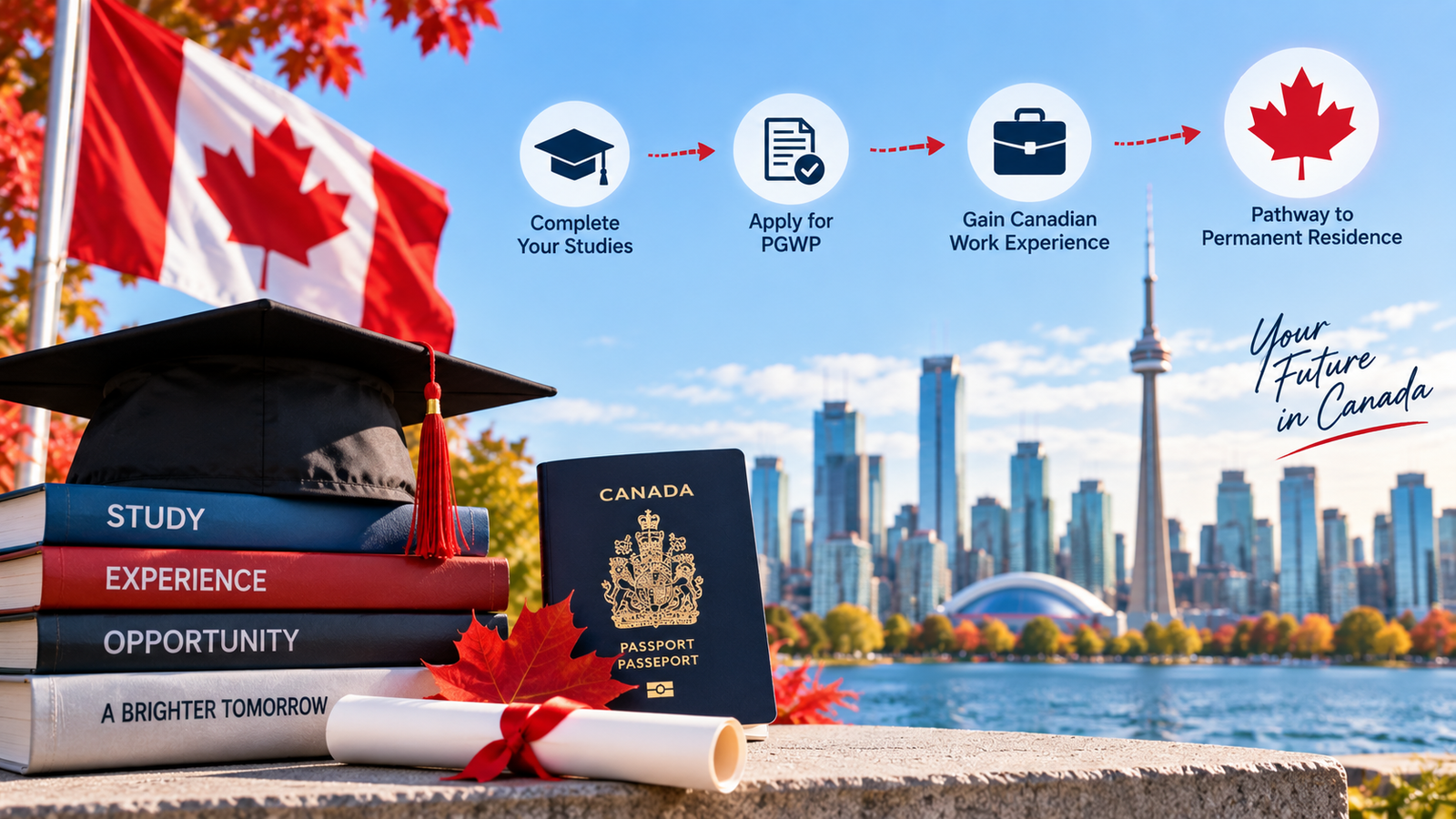
Canada Study Permit Guide: Requirements and Application Steps
Canada Study Permit Guide 2026
Studying in Canada can create valuable educational and career opportunities, but receiving a letter of acceptance from a Canadian school is only one part of the process. Most international students must also obtain a study permit from Immigration, Refugees and Citizenship Canada (IRCC).
This guide explains the main requirements, documents and decisions you should understand before applying.
Last reviewed: September 23, 2026
What is a Canadian study permit?
A study permit is an immigration document that authorizes an international student to study at a designated learning institution in Canada.
A study permit is not a visitor visa. If your application is approved, IRCC will normally issue the appropriate temporary resident visa or electronic travel authorization when one is required for travel.
People planning to study in Canada for more than six months will generally need a study permit. Some exceptions exist, so applicants should confirm their requirements through the official IRCC website.
Who can apply for a study permit?
To qualify, an applicant generally must:
• Be accepted by a designated learning institution, commonly called a DLI.
• Demonstrate enough money for tuition, living expenses and return transportation.
• Obey Canadian law and provide a police certificate if requested.
• Complete an immigration medical examination when required.
• Convince the immigration officer that they will respect the conditions of their temporary stay.
• Provide all additional documents required for their country or circumstances.
Admission to a Canadian school does not guarantee approval of a study permit. IRCC assesses the complete application.
Choose your school and program carefully
Before paying tuition, confirm that the school appears on Canada’s official DLI list.
Being a DLI does not automatically mean that every program offered by that institution qualifies a graduate for a post-graduation work permit. If working in Canada after graduation is part of your plan, check the PGWP eligibility of both the institution and the specific program before accepting an offer.
Your proposed program should also make sense in relation to your previous education, employment history and future objectives. Your application should clearly explain why you selected the program and how it supports a realistic educational or career plan.
Documents commonly required
Requirements differ between applicants, but a study permit application may include:
• A valid passport or travel document.
• A letter of acceptance from a DLI.
• A provincial attestation letter or territorial attestation letter when required.
• A Quebec Acceptance Certificate if studying in Quebec.
• Proof of tuition payments, when applicable.
• Proof of financial support.
• Academic transcripts and certificates.
• Language test results when requested by the institution or relevant to the application.
• A study plan or letter of explanation.
• Police certificates when required.
• Medical examination results when required.
• Biometrics.
• Documents for accompanying family members.
• Additional documents listed by the responsible visa office.
Documents not written in English or French may require a certified translation. Always follow the instructions applicable to the country or region from which you are applying.
Do you need a PAL or TAL?
A provincial attestation letter or territorial attestation letter confirms that a province or territory has allocated a place to the applicant. A PAL or TAL is usually provided through the student’s school and is required for many study permit applications.
Exceptions exist. For example, beginning January 1, 2026, applicants to degree-granting master’s or doctoral programs at public institutions do not generally need a PAL or TAL.
Because the exemptions and procedures can change, check the current IRCC rules before submitting your application.
How much money must you show?
You must demonstrate that you can pay for:
• Tuition fees.
• Living expenses for yourself and accompanying family members.
• Transportation to and from Canada.
For applications made on or after September 1, 2026, one applicant studying outside Quebec must generally demonstrate at least CAD $23,448 for first-year living expenses. This amount does not include tuition or transportation.
Higher amounts apply when family members accompany the student. Quebec uses separate financial requirements. IRCC updates these figures, so always verify the amount that applies on the date you apply.
Acceptable financial evidence may include bank statements, proof of an education loan, proof of tuition or housing payments, scholarship documents or evidence of financial support from another person.
The funds should be genuine, available and supported by documents that clearly explain their source. A recent unexplained deposit may raise questions if the applicant does not provide supporting evidence.
How to apply
Most applicants must apply online before travelling to Canada.
A typical process includes:
1. Receive an eligible letter of acceptance.
2. Obtain a PAL, TAL or CAQ when required.
3. Collect identity, financial and academic documents.
4. Prepare a clear study plan or letter of explanation.
5. Complete the online application forms accurately.
6. Pay the required government fees.
7. Submit biometrics or complete a medical examination when instructed.
8. Monitor your IRCC account for messages and document requests.
9. Wait for a decision before making irreversible travel arrangements.
The government processing fee for a study permit is currently CAD $150 per applicant. A separate biometrics fee may apply.
Processing times vary according to the applicant’s location, application volume and the complexity of the file. An estimated processing time is not a guarantee.
Writing a strong study plan
A study plan should be personal, specific and supported by evidence. It can explain:
• Why you selected Canada.
• Why you chose the institution and program.
• How the program relates to your previous studies or work.
• Why a comparable program is not the best option in your home country.
• How the qualification will support your career.
• How you will finance your education.
• What ties and responsibilities connect you to your home country.
• How you intend to comply with the conditions of temporary residence.
Avoid copying a generic letter from the internet. The information in your study plan must agree with your forms and supporting documents.
Common reasons an application may be refused
A study permit may be refused when an officer is not satisfied about matters such as:
• The purpose of the proposed studies.
• The applicant’s ability to pay tuition and living expenses.
• The source or availability of funds.
• The relationship between the proposed program and the applicant’s background.
• Missing, inconsistent or unreliable documentation.
• Whether the applicant will comply with temporary-resident conditions.
• Whether the applicant is medically or criminally admissible.
No document or consultant can guarantee approval. A complete application should address the applicant’s individual circumstances honestly and consistently.
Can international students work in Canada?
Eligible students may work off campus for up to 24 hours per week during regular academic sessions and may work unlimited hours during qualifying scheduled breaks.
Students must meet all eligibility requirements and respect the conditions printed on their permits. A student cannot begin working before the study program starts.
Working more hours than permitted can violate study permit conditions and may affect future immigration applications.
Changing schools in Canada
International students should not assume they can freely change institutions using the same permit.
Post-secondary students changing to another DLI generally need to apply for a new study permit or extend their current permit before beginning studies at the new institution. Different procedures may apply when changing programs at the same institution.
Check the current IRCC instructions before changing schools or programs.
After graduation
Graduates of certain eligible programs may qualify for a post-graduation work permit. Eligibility can depend on:
• The institution and program.
• The program’s duration.
• The date the study permit application was submitted.
• Language requirements.
• Field-of-study requirements in applicable cases.
• The student’s status and study history.
Do not select a program based only on an assumption that it will lead to a PGWP or permanent residence. Verify the current rules before paying a deposit.
Final checklist
Before submitting your study permit application, ask:
• Is my school a recognized DLI?
• Is my specific program PGWP-eligible if that matters to my plans?
• Do I need a PAL, TAL or CAQ?
• Have I shown sufficient funds using the current requirement?
• Are my forms and supporting documents consistent?
• Does my study plan clearly explain my educational objective?
• Have I included translations where required?
• Have I reviewed the document instructions for my country?
• Is every statement truthful and supported by evidence?
Final thoughts
A successful study permit application is more than a collection of forms. It should present a clear and credible educational plan supported by reliable financial, academic and personal documentation.
Start early, verify the current rules and avoid making major financial commitments based on assumptions. Canadian immigration requirements can change, and the rules that applied to another student may not apply to you.
Official resources
Study permit eligibility:
https://www.canada.ca/en/immigration-refugees-citizenship/services/study-canada/study-permit/eligibility.html →
Required documents:
https://www.canada.ca/en/immigration-refugees-citizenship/services/study-canada/study-permit/get-documents.html →
Proof of financial support:
https://www.canada.ca/en/immigration-refugees-citizenship/services/study-canada/study-permit/get-documents/financial-support.html →
How to apply:
https://www.canada.ca/en/immigration-refugees-citizenship/services/study-canada/study-permit/apply.html →
This article provides general educational information and is not legal advice. Requirements and government policies can change. Verify current information with IRCC or obtain advice from an authorized Canadian immigration professional before making a decision.
Would you like professional guidance?
Every study permit application is different. If you have questions about your documents, financial evidence, study plan or immigration options, you may choose to discuss your circumstances with an authorized Canadian immigration professional.
Talk to an Immigration Professional →
Professional assistance does not guarantee approval. Immigration decisions are made exclusively by Canadian immigration authorities.