Permanent Residence in Canada for International Graduates: 2026 Pathways

Permanent Residence in Canada for International Graduates: 2026 Pathways
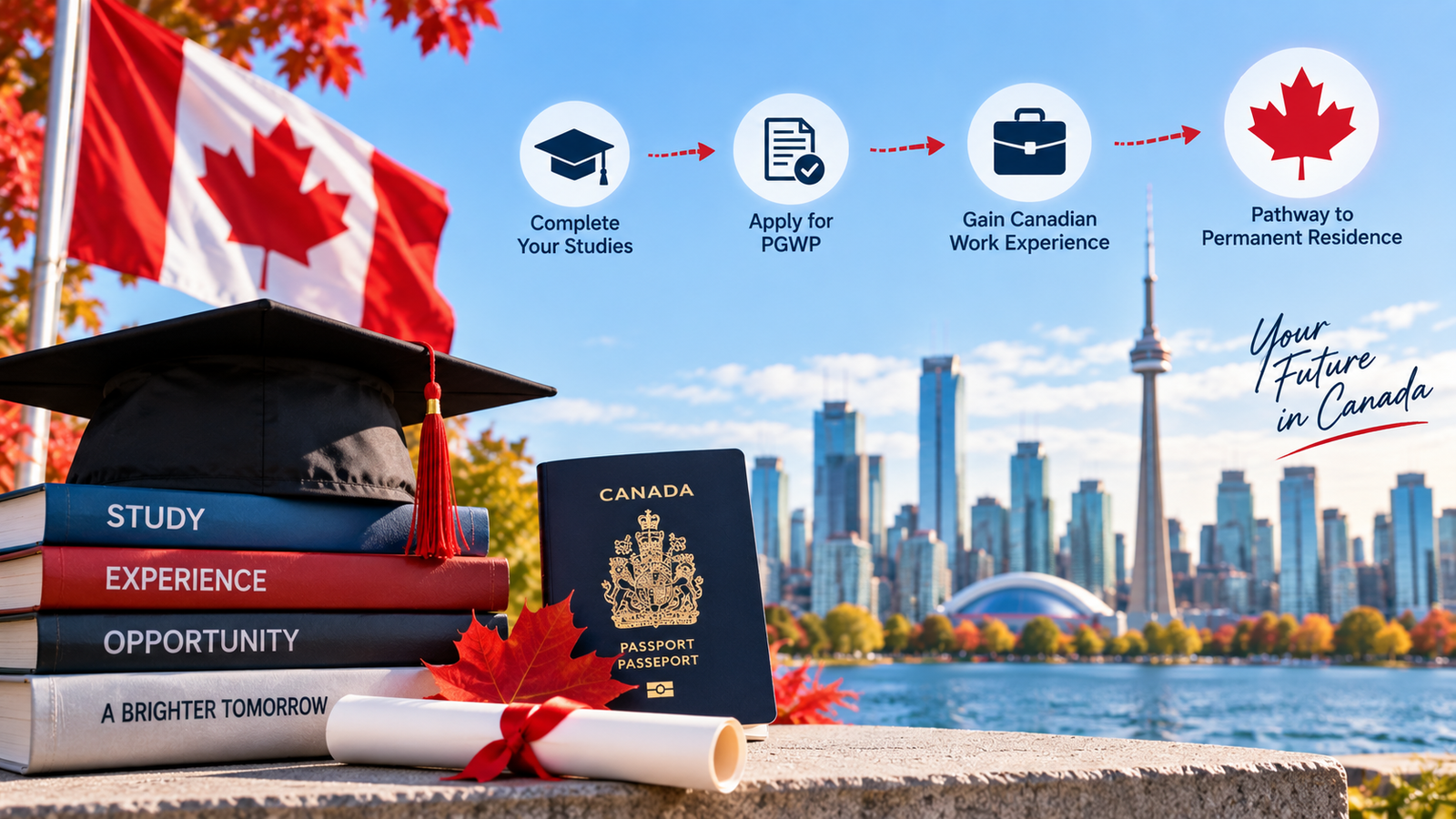
Completing a Canadian education can strengthen your immigration profile, but graduating from a Canadian school does not automatically provide permanent residence.
A study permit, post-graduation work permit and permanent resident status are three different things. Each has separate eligibility requirements, deadlines and application procedures.
International students who hope to remain in Canada should begin researching permanent-residence pathways before graduation rather than waiting until their work permit is close to expiring.
Last reviewed: September 23, 2026
Does studying in Canada guarantee permanent residence?
No. Neither a Canadian credential nor a post-graduation work permit guarantees permanent residence.
A Canadian graduate must qualify through an available immigration program and, where applicable, receive an invitation or provincial nomination.
Eligibility may depend on:
• Age.
• Canadian and foreign education.
• English and French language results.
• Canadian and foreign work experience.
• Occupation and job duties.
• Province of residence.
• A qualifying job offer.
• Family circumstances.
• Immigration status.
• Admissibility to Canada.
• Current program quotas and selection priorities.
Immigration programs can open, close or change. A pathway available when you begin studying may be different when you graduate.
Express Entry
Express Entry is the federal system used to manage applications under:
• The Canadian Experience Class.
• The Federal Skilled Worker Program.
• The Federal Skilled Trades Program.
Qualifying for one of these programs allows you to enter the Express Entry pool. It does not guarantee an invitation to apply.
Candidates receive a Comprehensive Ranking System score based on factors such as age, education, official-language ability, Canadian work experience and accompanying spouse qualifications.
IRCC conducts invitation rounds that may be:
• General.
• Program-specific.
• Provincial Nominee Program rounds.
• Category-based selection rounds.
The required CRS score changes from one invitation round to another. Avoid relying on an old score or assuming that a particular threshold will return.
Canadian education points
Eligible Canadian post-secondary education can provide additional CRS points:
• 15 points for an eligible Canadian credential from a program lasting one or two years.
• 30 points for an eligible credential from a program lasting three years or longer, or for certain master’s, professional or doctoral credentials.
The credential must meet Express Entry’s Canadian-education criteria.
As of March 25, 2025, job offers no longer receive additional CRS points. A job offer can still be important for eligibility under particular immigration programs, but it no longer provides the previous 50 or 200 CRS points.
Calculate an estimated CRS score:
Check Your CRS Score →
Canadian Experience Class
The Canadian Experience Class, commonly called CEC, is a popular federal pathway for graduates who obtain eligible Canadian work experience after completing their studies.
An applicant generally needs at least:
• One year or 1,560 hours of eligible Canadian work experience.
• Work acquired during the three years before applying.
• Paid and authorized employment.
• Experience in an occupation classified within an eligible NOC TEER category.
• Performance of the lead statement and most main duties associated with the selected NOC.
• Approved English or French language results meeting the required level.
• A plan to live outside Quebec.
• Admissibility to Canada.
Work performed while studying full-time generally does not count toward the CEC minimum work-experience requirement, even when the student was legally authorized to work.
Self-employment also generally does not count toward the CEC minimum, subject to limited exceptions.
This is why many graduates obtain a PGWP and build eligible work experience after completing their studies.
Language requirements for CEC
CEC language requirements depend on the occupation’s TEER category.
Applicants must take an IRCC-approved English or French language test and meet the required score in:
• Reading.
• Writing.
• Listening.
• Speaking.
Improving an official-language score can increase both eligibility and the applicant’s CRS ranking.
Federal Skilled Worker Program
A graduate who does not yet have one year of eligible Canadian work experience may qualify through the Federal Skilled Worker Program using eligible foreign or Canadian work experience.
The program assesses factors including:
• Skilled work experience.
• Language ability.
• Education.
• Age.
• Arranged employment where relevant to eligibility.
• Adaptability factors.
Applicants must first satisfy the Federal Skilled Worker eligibility requirements, including the program’s selection-factor threshold. They must then compete in the Express Entry pool using their CRS score.
Unlike CEC, certain paid, continuous student work may count toward the Federal Skilled Worker minimum requirements if all applicable conditions are satisfied.
Federal Skilled Trades Program
Graduates who qualify in an eligible skilled trade may consider the Federal Skilled Trades Program.
This pathway has requirements concerning:
• Eligible trade work experience.
• The occupation’s NOC classification.
• Language results.
• A qualifying job offer or Canadian certificate of qualification.
• Admissibility and intended province of residence.
Student work experience does not count toward the minimum experience requirement for the Federal Skilled Trades Program.
Category-based Express Entry selection
IRCC can hold Express Entry rounds focusing on candidates with particular attributes, such as:
• French-language proficiency.
• Experience in selected occupations.
• Experience in sectors identified as economic priorities.
• Other categories established by the government.
Category-based eligibility does not replace the need to qualify for an Express Entry program. Categories and eligible occupations can change, so verify current requirements rather than selecting a study program solely because of a past invitation category.
Provincial Nominee Programs
Most provinces and territories operate Provincial Nominee Programs, commonly called PNPs.
Some streams target:
• International graduates.
• Graduates of institutions in that province.
• Workers with local employment experience.
• Graduates with an employer-supported job offer.
• Master’s or doctoral graduates.
• Workers in priority occupations.
• Candidates with strong connections to the province.
• Entrepreneurs.
Requirements differ considerably. A stream may require:
• Graduation from an institution in that province.
• A qualifying job offer.
• Employment in the field of study.
• A minimum period of local work experience.
• Language-test results.
• Proof of settlement funds.
• An intention to live permanently in the nominating province.
• Employer approval or registration.
A nomination connected to Express Entry provides 600 additional CRS points. A province may also nominate applicants through a non-Express Entry process.
A provincial nomination requires a genuine intention to live in the province or territory that issued it.
Quebec and Nunavut do not participate in the PNP system. Quebec manages its own economic immigration selection programs.
Atlantic Immigration Program
The Atlantic Immigration Program may provide a pathway for graduates who want to live in:
• New Brunswick.
• Nova Scotia.
• Prince Edward Island.
• Newfoundland and Labrador.
Applicants need a qualifying job offer from a designated Atlantic employer and an endorsement from the province.
Certain recent graduates of recognized Atlantic Canadian institutions can be exempt from the program’s work-experience requirement if they:
• Completed an eligible credential lasting at least two years.
• Studied full-time.
• Graduated within the required period.
• Lived in an Atlantic province for the required time.
• Held the required immigration status.
The program still has additional requirements involving the job offer, language, education, settlement plan and provincial endorsement.
Immigration options in Quebec
Quebec selects economic immigrants through programs separate from Express Entry and the PNPs.
Graduates planning to settle in Quebec should review current Quebec requirements relating to:
• Type and location of education.
• Quebec work experience.
• French-language ability.
• Eligible occupations.
• Invitations and selection criteria.
• A Quebec Selection Certificate.
• Federal admissibility and permanent-residence processing.
Quebec programs have changed substantially over time. Do not rely on an older article or assume that graduation from a Quebec institution creates automatic eligibility.
Family sponsorship
A genuine spouse or common-law partner who is a Canadian citizen or permanent resident may be able to sponsor an eligible partner.
Family sponsorship is not a shortcut based only on marriage. The relationship must be genuine and satisfy all legal requirements.
The sponsor must also be eligible. Misrepresentation or entering a relationship primarily to obtain immigration status can have serious consequences.
An applicant in Canada should separately confirm whether they qualify for an open work permit during processing. Submitting a sponsorship application does not automatically authorize employment in every situation.
French-language ability
Strong French can significantly improve an immigration profile.
Express Entry currently provides additional CRS points to candidates with qualifying French results. French ability may also create access to category-based invitation rounds or provincial pathways.
Applicants must normally provide results from an approved French test, such as TEF Canada or TCF Canada. Informal language ability or school attendance does not replace an approved test when one is required.
Start planning before graduation
A good permanent-residence plan considers several timelines:
• Study permit expiry.
• Program-completion date.
• PGWP application deadline.
• Passport expiry.
• Language-test validity.
• Time required to obtain eligible work experience.
• Express Entry profile expiry.
• Provincial stream opening and closing dates.
Waiting until a PGWP is nearly expired can reduce your options.
Choosing employment strategically
Not every job provides the same immigration value.
Before accepting a position, identify:
• The correct NOC code.
• The occupation’s TEER category.
• Whether the duties match the NOC description.
• Whether the employment is authorized.
• Whether it is paid employment.
• Whether self-employment is excluded.
• Whether the work qualifies for the intended program.
• Whether the province has a relevant nomination pathway.
Job title alone is not enough. Immigration officers assess the actual duties performed.
Keep employment evidence
Maintain records such as:
• Employment contracts.
• Detailed employer reference letters.
• Pay statements.
• T4 tax slips.
• Notices of Assessment.
• Records of Employment.
• Work schedules.
• Work permits.
• Bank records showing payroll deposits.
A reference letter should normally show employment dates, hours, salary, benefits and detailed duties.
Protect your temporary status
Being eligible for or invited under an immigration program does not automatically extend temporary status.
Submitting an Express Entry profile is not a permanent-residence application and does not provide authorization to stay or work in Canada.
Even submitting a permanent-residence application does not automatically extend every work permit. A person may need a bridging open work permit or another status document and must independently meet its requirements.
Monitor permit expiry dates and take action before losing status.
Build more than one possible pathway
Immigration policies and selection priorities change. Graduates should avoid depending on only one projected pathway.
A stronger plan may include:
• Improving English results.
• Learning or improving French.
• Obtaining eligible Canadian work experience.
• Researching provincial programs.
• Considering eligible employment in another province.
• Ensuring work duties match the correct NOC.
• Keeping valid temporary status.
• Monitoring federal and provincial policy changes.
Common mistakes
Graduates should avoid:
• Assuming a PGWP guarantees permanent residence.
• Counting full-time student work toward CEC eligibility.
• Using the wrong NOC based only on job title.
• Relying on an outdated CRS score.
• Assuming a job offer still provides CRS points.
• Moving away from a nominating province without understanding the consequences.
• Letting a permit expire while waiting for an invitation.
• Using expired language results.
• Depending on an immigration stream that is paused or closed.
• Providing incomplete or inaccurate employment evidence.
Permanent-residence planning checklist
Ask yourself:
• Which immigration programs could I qualify for?
• When does my current permit expire?
• How much eligible work experience have I completed?
• Does my job meet the correct NOC requirements?
• Are my language results valid?
• What is my estimated CRS score?
• Can stronger English or French improve my score?
• Does my province offer a suitable stream?
• Do I genuinely intend to remain in that province?
• Do I have a backup plan if I do not receive an invitation?
Official information
Canadian Experience Class:
https://www.canada.ca/en/immigration-refugees-citizenship/services/immigrate-canada/express-entry/who-can-apply/canadian-experience-class.html →
CRS scoring criteria:
https://www.canada.ca/en/immigration-refugees-citizenship/services/immigrate-canada/express-entry/check-score/crs-criteria.html →
Provincial Nominee Program:
https://www.canada.ca/en/immigration-refugees-citizenship/services/immigrate-canada/provincial-nominees.html →
Atlantic Immigration Program:
https://www.canada.ca/en/immigration-refugees-citizenship/services/immigrate-canada/atlantic-immigration.html →
Would you like professional guidance?
Moving from temporary student status to permanent residence can involve several programs, deadlines and strategic decisions. If you need help understanding which current pathways may fit your circumstances, you may choose to speak with an authorized Canadian immigration professional.
Talk to an Immigration Professional →
Professional assistance does not guarantee an invitation, nomination or approval. Immigration decisions are made exclusively by Canadian immigration authorities.
This article provides general educational information and is not legal advice. Immigration programs, quotas and selection criteria can change. Verify current requirements with IRCC and the relevant province before making decisions.